

Mixed-Use — Feasibility Study
5 Blue Street — Zurich Feasibility Study
Category
Mixed-Use — Feasibility Study
Location
5 Blue Street, North Sydney NSW
Size
N/A
Year
2015
The Project
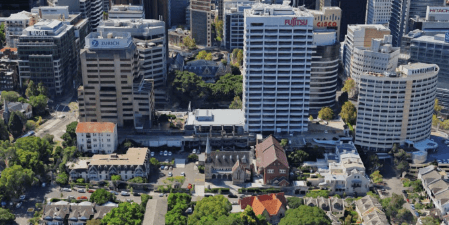
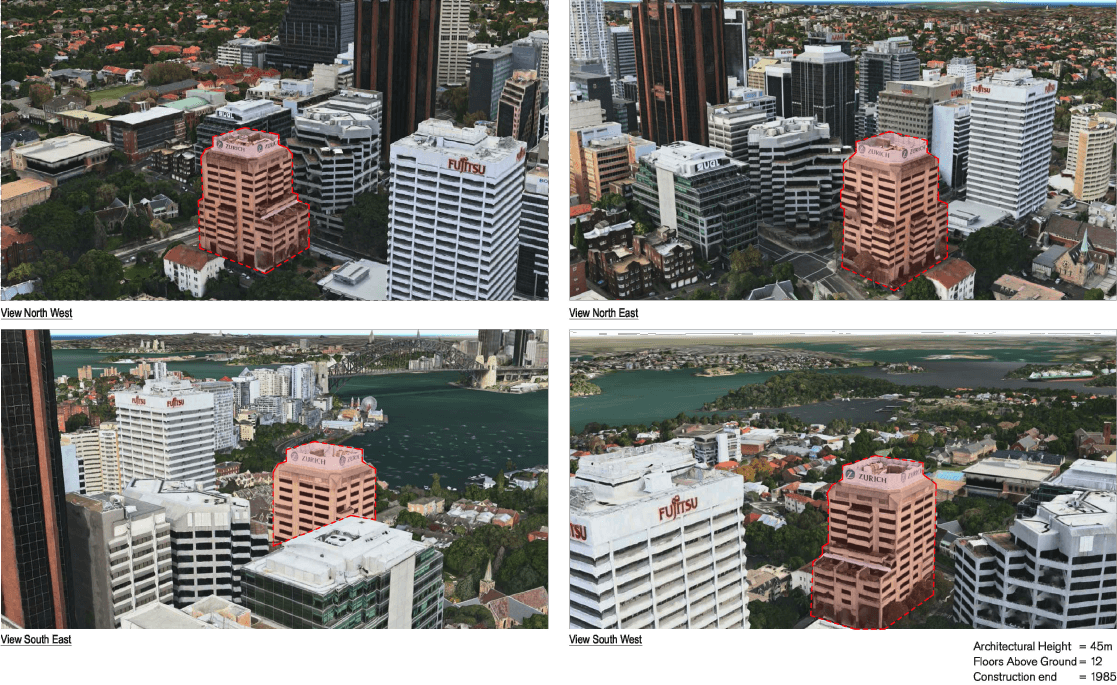
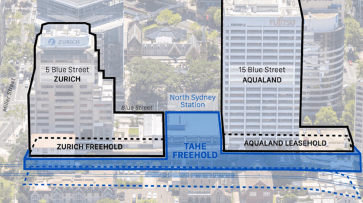
5 Blue Street is a 3,007-square-metre freehold site in the heart of North Sydney's CBD, home since the 1970s to Zurich Financial Services' 14-storey Australian headquarters. In 2016, Zurich engaged FJMT Studio to explore the redevelopment potential of the site, an exercise in yield optimisation, massing analysis and stratum coordination for one of the most structurally complex parcels in the North Sydney commercial core. The site sits directly above the North Sydney Station rail corridor, meaning any future development must negotiate a layered ownership structure between Zurich's freehold, the Transport Asset Holding Entity (TAHE) freehold beneath, and the adjoining Aqualand leasehold at 15 Blue Street.
The Challenge
The analytical challenge was threefold. The stratum arrangement meant structural columns and loadpaths threaded through active rail infrastructure below; any redevelopment envelope had to respect those subterranean constraints while maximising developable area above. The relationship with the neighbouring Aqualand building at 15 Blue Street added another dimension, as the two properties share a publicly accessible plaza connecting through to the station entry. And North Sydney's planning controls imposed height and floor space ratio limits that required a fine-grained understanding of where yield could actually be captured within the three-dimensional envelope.
My Approach
I worked on this feasibility study as a Graduate Architect within the FJMT team, with a particular focus on developing the blocking and stacking analysis, testing how residential, commercial and servicing uses could be arranged vertically within the allowable building envelope. This required me to build a detailed understanding of the structural and spatial relationships between the Zurich tower, the neighbouring Aqualand building, and the overall complex as a stratum, including the interaction with the active station infrastructure directly beneath.
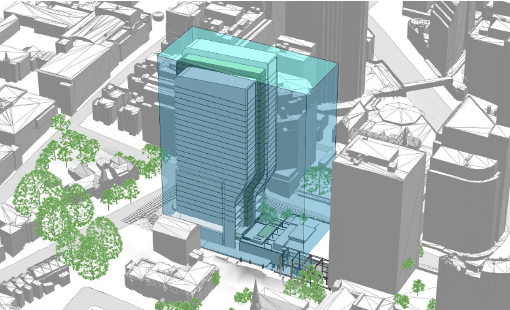
I tested tower height, setbacks and floorplate efficiency under the applicable planning controls, working through the maximum achievable gross floor area for a mixed-use programme combining residential apartments, commercial office space and an upgraded public plaza at street level. The goal was to give Zurich a clear picture of their site's development capacity and the planning pathway required to unlock it.
The Outcome
The feasibility study established the development framework that Zurich has continued to advance over the following decade. In 2025, Zurich lodged a State Significant Development application for a 29-storey mixed-use tower comprising approximately 335 dwellings, ground-level commercial premises and the upgrade of Blue Street Plaza. Seeing the blocking-and-stacking principles I contributed to in 2016 underpin a formal SSD submission nearly a decade later was a powerful reminder of how early-stage analysis shapes a site's long-term trajectory.
For me, this project was foundational. It taught me to think about development sites the way a developer does, at the intersection of planning controls, structural constraints and commercial yield. That feasibility-stage mindset is now central to how I advise clients at Yaxley Studio, where understanding whether a site is viable comes before any design work begins.